Sunday, November 25, 2012

Thanksgiving in Nigeria

We are doing well here.  We are trying to figure out what we can do to make a little difference.  
The needs are overwhelming.

We have discovered why the men are so old here when they get married.  There is something called a "bride price".  The man must pay a very large amount of money to the bride's family if he wants to marry.  Besides that he must pay for all the costs of weddings...(plural).  Each village that the families are associated with have special ceremonies and celebrations that the groom must also pay for.  Then on top of that, he must pay for an apartment for a year in advance (anyone who rents an apartment must do so).  There is no credit, cars must be paid for entirely.  There are no such things as car payments or loans.

We are loving this country and the people here.  We are actually beginning to understand what most people are saying.  Despite the poverty, there is a strong spirit of hope.  The people are loving and caring and families are everything to them.

We were invited to a wedding and found that we needed to purchase material from the bride's friend.  Evidently, everyone at the wedding wears a dress or shirt made from the same fabric.  The bride told us that this is the tradition.   A lady came over this evening and took our measurements.  Besides our usual activities working in the mission we went shopping on Friday in an area where artists display their wares.  We purchased a mask and some African figures.  I think we will go back as the prices were fairly reasonable and the art work was amazing.  On our way to the art area on a busy long bridge one of our tires blew...and completely shredded.  We will send pictures next week.  Elwood was out directing traffic.  We also bought 150 roll on deodorants at a local store to give to the missionaries as part of their Christmas present.  (As I have mentioned before, this is needed!)

Thanksgiving was quite different this year.  The night before we went with the mission president and his wife along with the other senior missionary couples to the Sheraton Hotel for dinner.  It was delicious...and the first time we have been to a real restaurant since we have been here as we are not encouraged to go 
out at night.

We put up a Charlie Brown Christmas tree on a little table in our apartment.  It actually is quite cheery.

Elwood has spent a lot of time checking out missionary apartments to see what needs to be done to make them more livable.  We have both been working with the mission president to assist him in what needs to be done to help make the mission more successful.

We love you all,
Penny and Elwood


Off-loading sand from sand barges.  They dredge where the river and ocean meet, load it on barges, off-load and sell

Plantain: a large fruit in the banana family cooking on a stove.  This is a very popular African food item.

Large tubers or yams, basic to the African diet. 

Penny and our shopping guide Freida at the huge shopping area called Balogun.

Moving product in Balogun.  Many "streets" are too narrow for a vehicle. 

Shoppers and two cars... even worse.

Now this is a crowd!

This is really dressing for work.

Carrying merchandise to stores 

Happy mother with child

Woman roasting corn at a shopping area in Maryland, which is a suburb of Lagos.

Penny purchased a basket

The roads are always muddy and rutted in the suburbs.

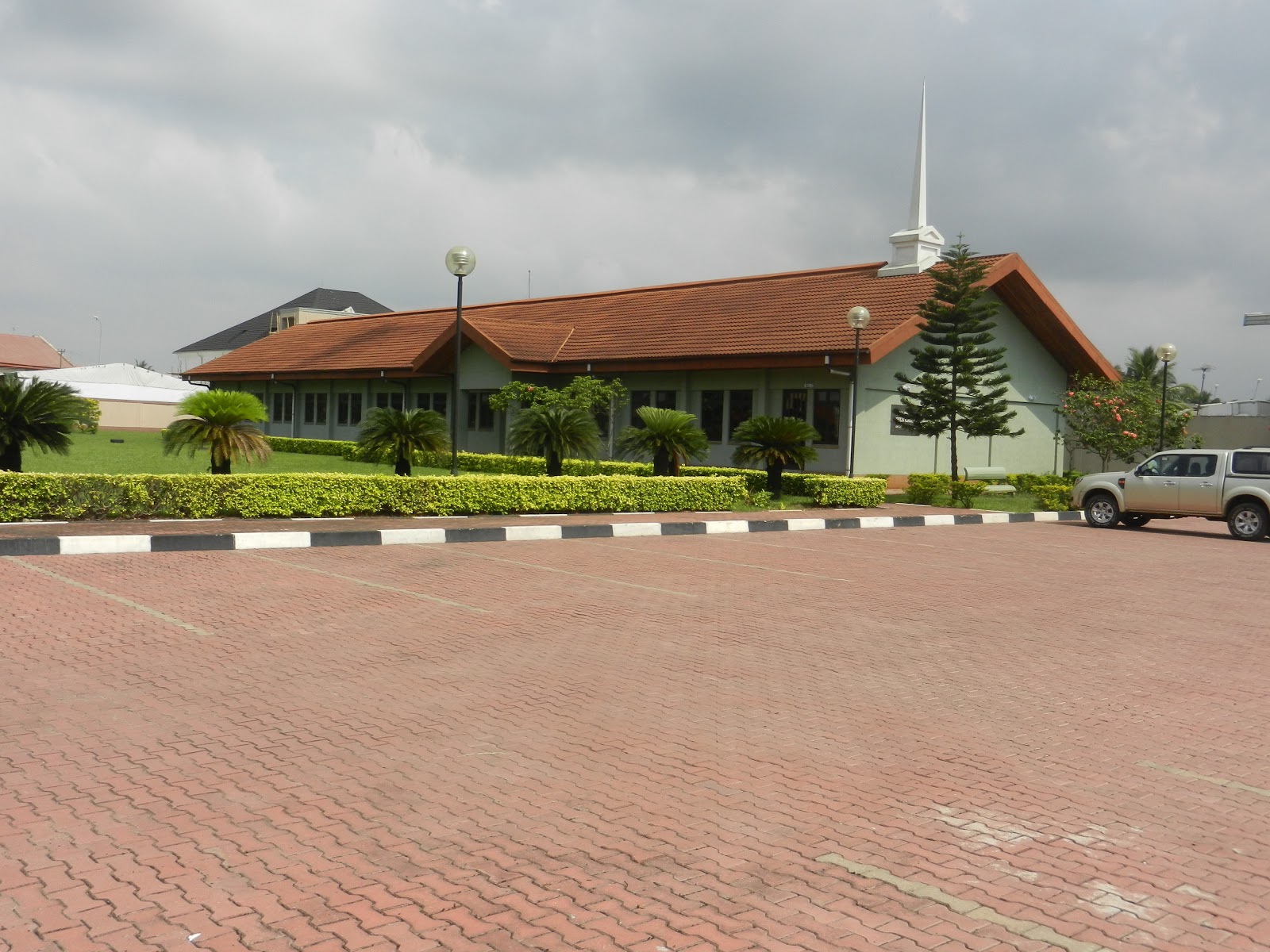
Festac Stake Center, quite nice on the outside. 
Elwood with the missionaries in Festac

Senior missionaries, President and Sister Adebayo, and Victor, the regional facilities manager,
after Thanksgiving eve dinner at the Sheraton Hotel - an unusual night out.

Tuesday, November 13, 2012

November in Lagos

Went shopping with our driver for Christmas gifts for the missionaries in our mission to a shopping district called Balogun. Many people wanted to discuss the election and were excited that a black man had been elected.  The shopping area consists of block after block of "shops" stacked on top of each other very precariously and jammed together side by side.  The walkway is very narrow; in some places allowing only one person to squeeze through and in other places a little wider.  Amazingly cars and kaykays drive through, honking loudly.  And you had better get out of the way or you would be bumped. 

 We were busy this week receiving 14 new missionaries - 13 from Nigeria and one from Ghana.  They were interviewed; received a short training; fed and sent on their way.  Many of them did not have necessities.  We gave them sheets, socks, pants, toiletries, a mosquito net, malaria pills, etc.  While all this was going on, another group of missionaries were being transferred to a new location.  This group was fed and then moved.  None of them have cars so the mission vans pick them up at their apartments, drive them to the mission home and then take them to their new location.  The living conditions are quite basic (as you may have seen on our blog). 

 We get together frequently in the evening with 2 other senior missionary couples for dinner and games.  We are not able to go out at night because of mosquitoes carrying malaria and the unsafe environment. We attended a devotional where a member of the African West Area Presidency told us that our area will be piloting a new teaching program using General Conference talks instead of manuals for the youth.  Another program he announced is to help find members who have moved and cannot be located.

An African woman

Ditch along the side of the street.  Typical, who knows what all goes into the ditch, they stink.

Typical scene

An unusual church "Synagogue, church of All Nations" 

Suburbs

Woman cooking near a ditch

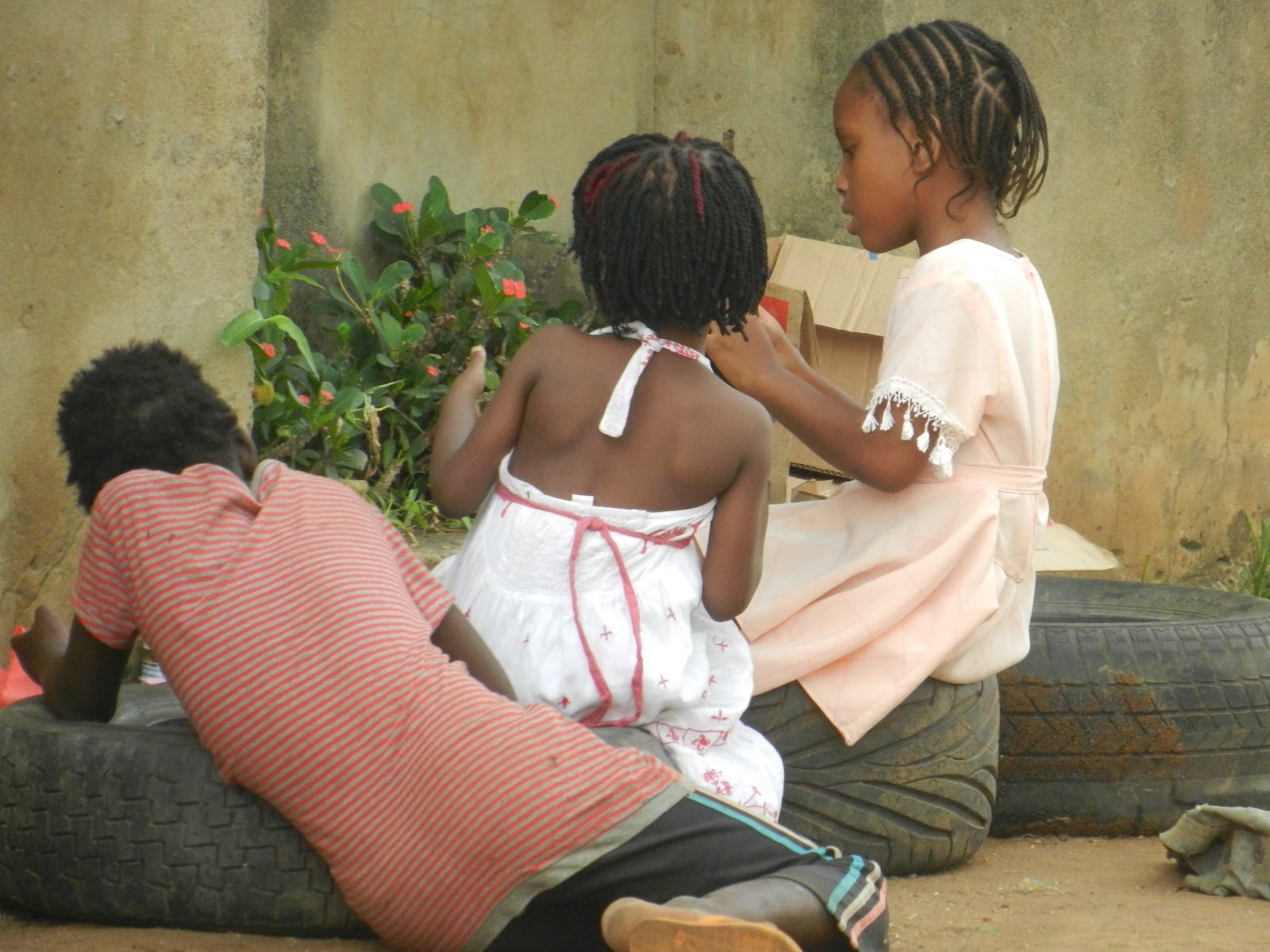
Kids at play

Kitchen, sleeping quarters, and motor cycles in a very small area 

Kids

LDS Church at Ejigbo 

LDS Church at Okokomaiko

Goats at play

This woman wants to make Penny an African style dress

This woman owns the sewing shop

Men in typical African dress

Tuesday, November 6, 2012

The streets of Lagos

Had an outing this week visiting missionary apartments for the placement of generators. As I have told you before, electricity goes out frequently so generators are a necessity. One apartment has not had electricity for two weeks. When electricity goes out the water does not pump from the bore holes. (There is no infrastructure providing water so everyone has to have a bore hole (deep well) providing water for the building or apartment.) So the missionaries have had to go outside to a well to get water and carry it up in buckets. We saw two bore holes that the Mormon Church provided in two areas allowing two small towns to have access to clean water. Most apartments in Lagos do not have a water heater so there are many problems with illness because people do not take the time to heat water to wash dishes or bathe. All the missionaries are provided with a water filtering system, but if electricity goes out it doesn't work properly. 

There are a few main streets that are paved in the outer areas of the city, but most are dirt and are deeply rutted making four wheel drive a necessity if you are in a vehicle. Some areas are cleaner than others, but trash is everywhere and people dump everything into the deep ditches by the side of the roads. Some ditches are covered and others are not. Goats are frequently seen in front of where people live and they wander in and out of the living quarters that are sometimes just huts. Most areas of the city have stalls side by side selling a variety of items and vendors wander through traffic offering sunglasses, belts, magazines, etc. There are so many needs here that it staggers the imagination. I just hope we will be able to help a little.

Women walking in front of stalls

One of the paved city streets with typical crowds

Missionary kitchen

Wife of one of the security guards with her baby 

Stalls and mothers with baby 

Women carry heavy loads on their heads 

Four of the sister missionaries

Bore hole (built by the Mormon Church) for one of the local areas allowing them to have fresh water

One of the many vans used as public transportation - a person is always hanging out 

This woman owns several apartment buildings, one of which is a building where four of our missionaries live 

These ditches are at the sides of all of the roads 

Tuesday, October 30, 2012

Second week in Lagos

This week we went on an excursion to the US Consulate on Victoria Island, which is part of the city of Lagos, for an update on safety issues and services for Americans in Nigeria.  It took us over 2 hours to get there and the same coming home...and it was only 15 miles away.  That is what traffic is like much of the time.    There are okadas that zip in and out (motorcycles carrying paying passengers) but other traffic is very slow.  The streets are in very poor condition and in many places are dirt roads with deep ruts.  People walk among the slow moving traffic selling various goods... from newspapers to electrical appliances.  All of this is in the middle of a city with many "booths" on the sides of the road selling cloth, leather goods, sunglasses, etc.  Thomas, one of the mission drivers, drove us...There were many times I closed my eyes as he made lanes that did not exist; narrowly missing nearby vehicles and people walking in the streets (in most places there are no sidewalks).  That is how all the drivers operate along with honking their horns for everyone to get out of their way.  It is hilarious.  We saw many living areas where people live in huts barely protected from the elements. 

One of the villages that our mission is working with is actually a leper colony.  ( I thought leposy had been eradicated.)  Medication is donated at no cost for the people in the village, but the government charges the villagers for this medicine to make money.  The people in the village cannot afford to buy the medicine so leprosy, and their suffering continues.  Our church is trying to get medicine and wheelchairs to the people in the village directly through a contact that has been working in the leper colony.  We are also trying to help them become financially independent by teaching them how to grow crops in order to afford the medication from the government.  The church is also drilling bore holes, here and in other villages so people can have fresh, unpolluted water.  Many villages still wash their clothes and bodies, as well as get drinking water, from a nearby stream that is usually not very clean. 

Thursday and Friday were Muslim holidays and almost everything was closed down so we took the opportunity to go back to Victoria Island to visit the National Museum of Nigeria.  (There was very little traffic...very unusual).  It portrayed the history of this part of Nigeria as well as the political history of the whole country.  There is too much to tell in this email, but it is a history of much violence...personal and political.  Not too many years ago twins were killed because they were thought to bring bad luck, political leaders were murdered as regimes have changed, and living conditions cause a high rate of infant deaths.  Amazingly, the Nigerian people are very resilient and most have great hope for their children's future. 

Not much gas in Lagos, so our driver had to put some gas in the car from the mission reserve.
Apartment Buildings
 A kay kay (three wheeled taxi).  Sometimes see six or more people riding.
A kay kay with a passenger. 
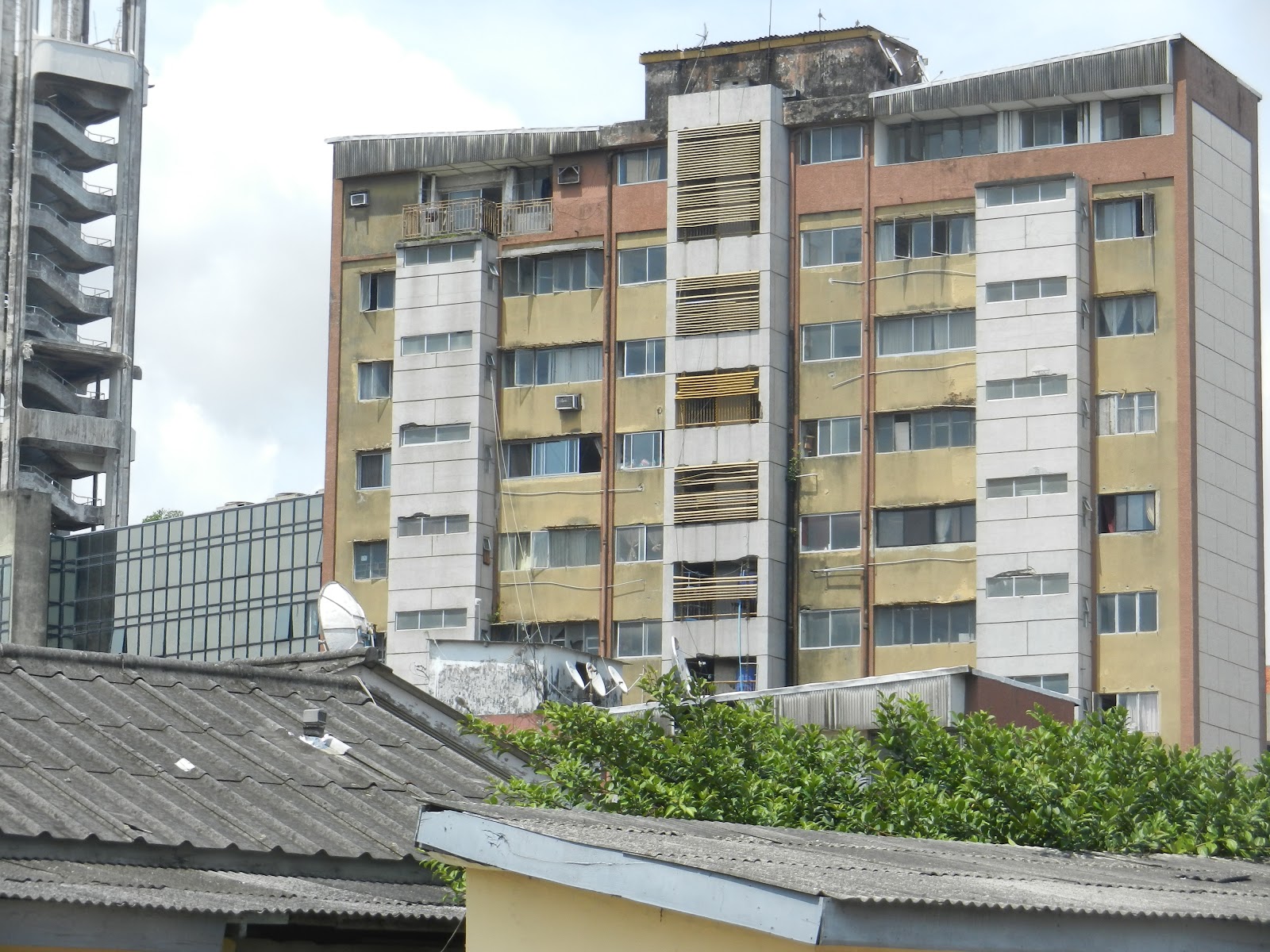
 High rise apartment building in very poor condition.
Museum of Nigeria.  Wonderful inside, but they refused to let us take pictures. 
High rise buildings on Victoria Island.  Some parts look fairly modern. 
An unusual street on Victoria Island.  This is as good as it gets. 
 Looking across the Lagos Lagoon.
 A shanti town, very depressing.
People selling on the street. 
People packed in a taxi van.  They sometimes hang out the sliding side door.